Location
-
Piazza Degli Eroi 14, 66020 Rocca San Giovanni Chieti, Italy

Piazza Degli Eroi 14, 66020 Rocca San Giovanni Chieti, Italy
Rocca San Giovanni is a small town in the province of Chieti located on top of a rocky hill that rises 155 meters above sea level between the mouth of the Sangro river and that of the Feltrino stream. The first traces of the town, found in a diploma signed by Emperor Henry III addressed to the Monastery of San Giovanni in Venere, date back to 1047.
But 1076 is the year that marks the birth of the first real inhabited nucleus.
Of clear medieval imprint, Rocca San Giovanni, placed on a rocky spur and entirely surrounded by cultivated fields, in the thirteenth century, thanks to the will of the Abbot Oderisio II, experienced a period of splendour: the circle of the inhabited area was enlarged; a mighty wall and three quadrangular towers were built with the aim of giving refuge, in the event of assaults, to the monks belonging to the Abbey of San Giovanni in Venere; moreover, churches and monuments were built which, unfortunately, have been lost over time. Some remains of the walls, a tower and the bell tower are still preserved, buildings that have now been skilfully restored.
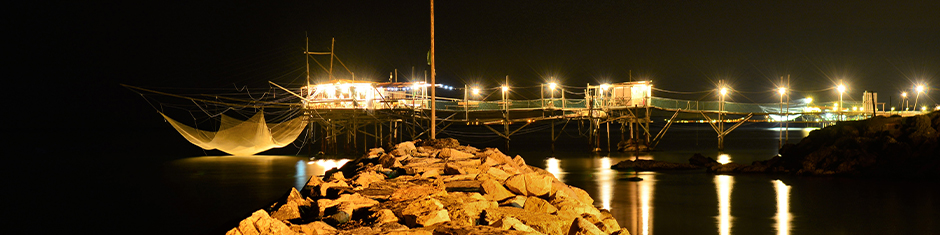
Among the exclusive peculiarities of the Abruzzo coast, the most famous and picturesque are the curious "fishing machines" of its southern stretch: the famous and celebrated overflows. Completely made of wood, they consist of a platform, supported by long poles, from which the fisherman lowers the net into the sea, and a long and bold walkway, also resting on poles, which connects to the mainland even tens of meters away.
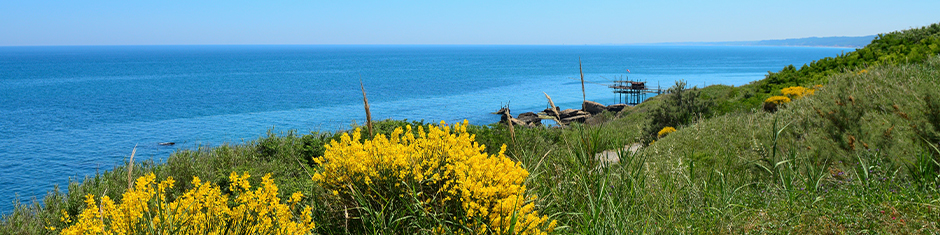
Gabriele d'Annunzio was bewitched by the charm of these places: in his tragedy The Triumph of Death, written in the quiet of his villa hidden among the cliffs of this stretch of coast, he described them thus: "That chain of promontories and lunar gulfs gave the image of a continuation of offerings, since each breast carried a cereal treasure. The brooms spread a golden mantle all over the coast. From each tuft rose a thick cloud of effluvium, as from a thurible. The breathed air was as delightful as a sip of elixir". The poet's residence, Villa Italia, still exists today. From the gate of the villa starts an easy path that descends towards the sea and leads to a few tens of meters from the overflow of Capo Turchino, one of the most important of the entire stretch of coast, mentioned in the Triumph of Death as a "machine" that " it seemed to have a life of its own."
Source: www.comuneroccasangiovanni.it
Rocca San Giovanni è un piccolo centro in provincia di Chieti disposto sulla sommità di un colle roccioso che si eleva a 155 metri dal livello del mare tra la foce del fiume Sangro e quella del torrente Feltrino. Le prime tracce della cittadina, reperibili in un diploma firmato dall’imperatore Enrico III indirizzato al Monastero di San Giovanni in Venere, risalgono al 1047.
Ma è il 1076 l’anno che segna la nascita del primo vero nucleo abitato.
Di chiara impronta medievale, Rocca San Giovanni, posta su uno sperone roccioso e circondata interamente da campi coltivati, nel tredicesimo secolo, grazie alla volontà dell’Abate Oderisio II, vive un periodo di splendore: la cerchia dell’abitato viene allargata; si costruisce una possente cinta muraria e tre torri quadrangolari con lo scopo di dare rifugio, in caso di assalti, ai monaci appartenenti all’Abbazia di San Giovanni in Venere; inoltre si edificano chiese e monumenti che con il tempo, purtroppo, sono andati perduti. Si conservano alcuni resti delle mura, un torrione e il campanile, costruzioni oggi sapientemente restaurate.
Fra le peculiarità esclusive della costa abruzzese, le più note e pittoresche sono le curiose “macchine da pesca” del suo tratto meridionale: i celebri e celebrati trabocchi. Completamente in legno, si compongono di una piattaforma, retta da lunghi pali, dalla quale il pescatore cala in mare la rete, e da una lunga e ardita passerella, anch’essa poggiata sui pali, che collega alla terraferma distante anche decine di metri.
Gabriele d’Annunzio fu stregato dal fascino di questi luoghi: nella sua tragedia Il Trionfo della Morte, scritta nella quiete della sua villa nascosta tra le rupi di questo tratto di costa, così li descrisse: “Quella catena di promontori e di golfi lunati dava l’immagine di un proseguimento di offerte, poiché ciascun seno recava un tesoro cereale. Le ginestre spandevano per tutta la costa un manto aureo. Da ogni cespo saliva una nube densa di effluvio, come da un turibolo. L’aria respirata deliziava come un sorso d’elisire”. La residenza del Vate, Villa Italia, esiste ancora oggi. Dal cancello della villa parte un facile sentiero che scende giù verso il mare e porta a qualche decina di metri dal trabocco di Capo Turchino, uno dei più importanti dell’intero tratto di costa, citato nel Trionfo della Morte come una “macchina” che “pareva vivere di vita propria”.
Fonte: www.comuneroccasangiovanni.it