Location
-
Sp37b, 64030 Castel Castagna Teramo, Italy
Sp37b, 64030 Castel Castagna Teramo, Italy
The church of Santa Maria di Ronzano stands isolated on a hill in the Mavone valley, in the locality of Ronzano, in the Abruzzo municipality of Castel Castagna, in the province of Teramo. The building belonged to the abbey monastic complex of the Benedictine order who also had the convent here, now disappeared.
Background
The exact date of construction of the factory is unknown, but various historians place its construction between 1170 and 1180.
The oldest documentary writing that mentions this church is a papal rescript drawn up in Anagni under the pontificate of Pope Lucius III, dated 21 January 1184.
Architecture
The architectural style of the church is characterized by a clear imprint of the Romanesque-Apulian style which is found in the layout of the windows, in the blind arches of the presbytery area and in the plan which, although internally it encloses three semicircular apses, appears rectilinear externally. These characteristics unite the Ronzano factory with the Apulian churches of the cathedral of Bitonto, the cathedral of San Corrado in Molfetta and the basilica of San Nicola in Bari.
Facade
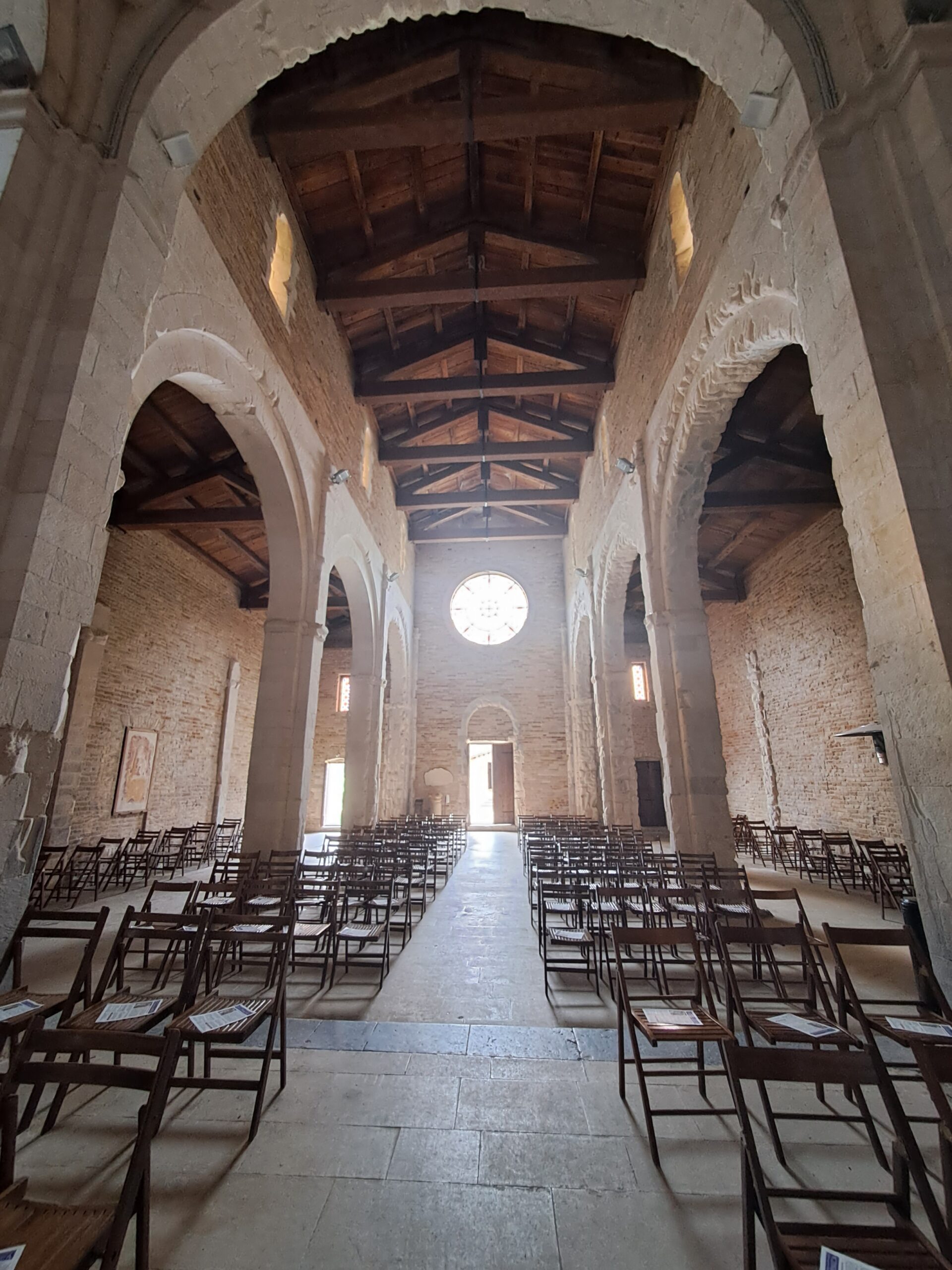
The tripartite sloping elevation was raised using smooth bricks, left exposed, arranged in cut, uniformly ordered and light-colored, squared stones, placed in correspondence with the movement of the internal arches and the perimeter walls. The facade is opened by three portals, two single lancet windows and a rose window now devoid of the sunburst, but which retains its frame.
External
The external walls of the sides of the church are also made up of bricks and stone ashlars, where the latter have been juxtaposed and ordered to generate forms of decoration that respect the same succession of internal arches.
The clear lines of the stone, which emerge from the red brick, draw a framework that frames blind arches between pilasters on both longitudinal portions and on the presbytery wall, where they join up with the four blind arches and the large single lancet window that opens in the center of the apse.
Single lancet window
The entire masonry fabric has single-lancet windows, some with slits, others of medium size delimited by barriers decorated with branch motifs and the largest in the apse area. This has larger dimensions than all the others, it opens between two small columns, resting on shelves, surmounted by capitals decorated with palmettes. Its outline is framed by a band carved with fruit and flowers and its compartment is barred by its perforated stone barrier worked in a checkerboard pattern.
Internal
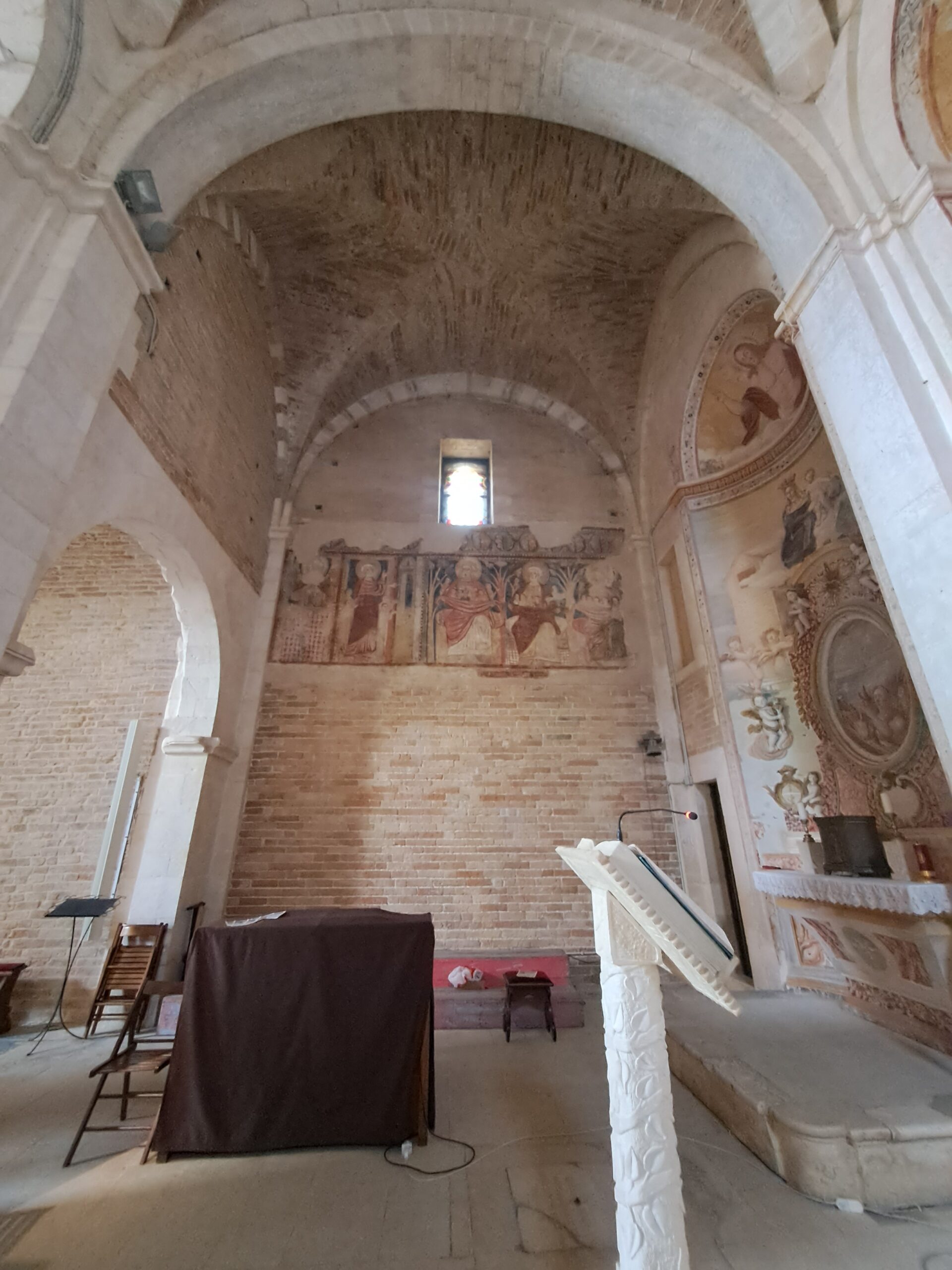
The space is divided into three large naves, the central one of which is higher. Each nave is made up of three passes, supported by cruciform pillars, and ends with an apse of modest depth. The portion of the interior where the naves stand has a trussed roof, while the presbytery area is enclosed by three cross vaults.
Frescoes
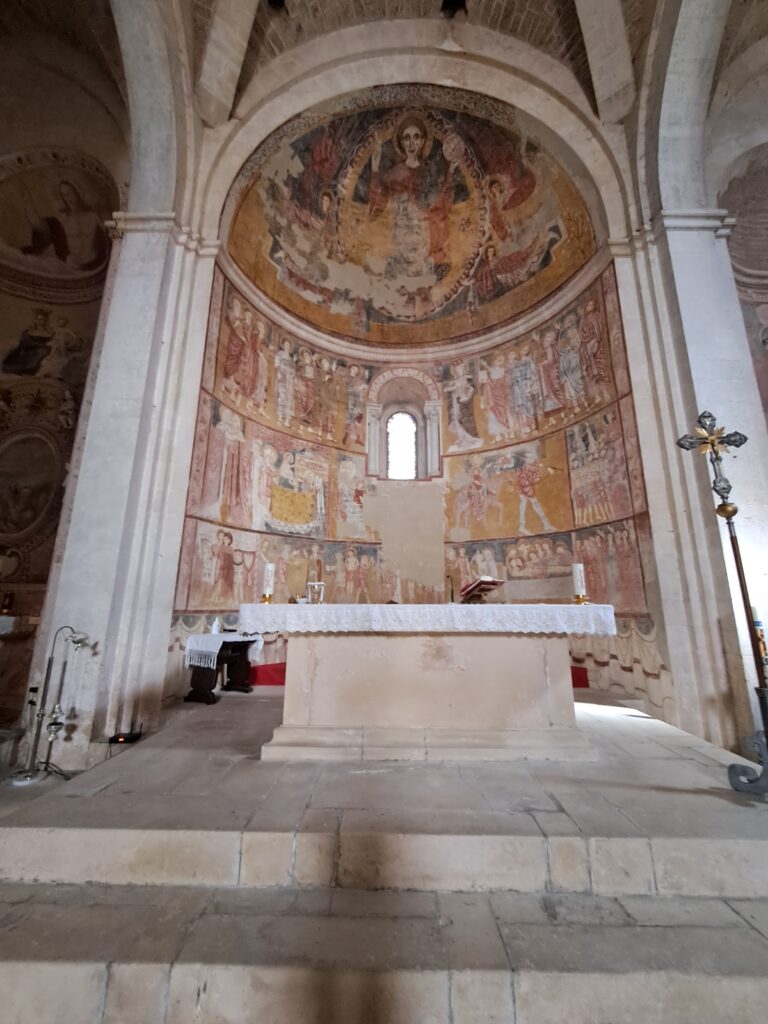
The apsidal basin contains a cycle of medieval frescoes dated 1181 or 1281, based on the interpretation that is given of the painted inscription that runs along the base of the apsidal dome.
In the apsidal dome, Christ blessing is represented inside a mandorla, surrounded by four flying angels: in his left hand he holds a disk on which is written EGO SUM LUX MUNDI or otherwise EGO SO(L)LUS MUNDI.
The twelve apostles are represented in the first register of the apse wall, with the representation of the Annunciation in the center, with the Virgin Mary and the Archangel Gabriel, respectively to the right and left of the window.
The scenes relating to Christ's childhood begin in the second register: the first scene on the left shows the Visitation of the Virgin Mary to Saint Elizabeth; the Nativity of Jesus follows, with the Child represented doubly.
In the center of the wall and immediately below the window, the Adoration of the Magi is represented, with the Madonna seated on a throne and the Child Jesus in her arms: the figures of the Magi have completely disappeared and only a part of the richly dressed horse remains. The scene of the Flight into Egypt follows, with the Madonna sitting on the donkey together with the Child and St. Joseph guiding them, holding a stick with a bundle and a barrel hanging on her shoulders, and wearing the pileus cornutus, the pointed cap used in the thirteenth century as a distinctive element for the Jews. The Slaughter of the Innocents is depicted in the last scene of the second register and many have linked it to the scene below, the last of the third register, variously interpreted as the pious women at the sepulcher or the weeping mothers of the innocents.
The third register shows the scenes relating to the Passion of Christ: the first depicts the Kiss of Judas and the capture of Christ by a multitude of soldiers dressed in armour; follows Christ before Pilate, carried by a soldier; the flagellation of Christ, flanked by two soldiers equipped with a whip and a stick; in the center of the register is the Crucifixion, which has partly disappeared, but it is still possible to admire the figure of Longinus on the left with the spear and the figure of the other soldier with the vinegar bucket. This is followed by the Request for the body of Christ to Pilate by the Madonna and Saint Peter; then the Deposition in the tomb.
The relic of the True Cross
The door at the end of the right aisle leads to a room which houses, among other things, an ancient and precious double-cross wooden cross covered in filigree gold foil and decorated with gems of different shapes, sizes and colours. In the body of the cross is inserted a wooden fragment also cruciform venerated as a relic of the True Cross of Jesus Christ. The Ronzano reliquary is of uncertain date but due to taste and use of the gems it can be dated between the 11th and 13th centuries.
Local legend has it that it was found in a field adjacent to the abbey during ploughing, it seems that the oxen that pulled the plow knelt down in the middle of the work despite the whipping of their driver, so the farmer decided to dig in front of the oxen where he found the case containing the Byzantine cross.
Source: www.valledelleabbazie.it
La chiesa di Santa Maria di Ronzano sorge isolata sopra un colle della valle Mavone, in località di Ronzano, nel comune abruzzese di Castel Castagna, in provincia di Teramo. L’edificio appartenne al complesso monastico abbaziale dell’ordine dei benedettini che qui ebbero anche il convento, ormai scomparso.
Cenni storici
L’esatta data della costruzione della fabbrica è sconosciuta, ma diversi storici collocano la sua edificazione tra il 1170 e il 1180.
La scrittura documentale più antica che cita questa chiesa è un rescritto papale redatto ad Anagni sotto il pontificato di papa Lucio III, datato 21 Gennaio 1184.
Architettura
Lo stile architettonico della chiesa è caratterizzato da una chiara impronta di stile romanico – pugliese che si ritrova nell’impostazione delle finestrature, negli archi ciechi della zona del presbiterio e nella pianta che, sebbene internamente racchiuda tre absidi semicircolari, esternamente appare rettilinea. Queste caratteristiche accomunano la fabbrica di Ronzano alle chiese pugliesi della cattedrale di Bitonto, del duomo di San Corrado a Molfetta e della basilica di San Nicola a Bari.
Facciata
Il prospetto, tripartito a spioventi, è stato alzato utilizzando laterizi lisci, lasciati a vista, disposti a taglio, ordinati uniformemente e pietre chiare, squadrate, poste in corrispondenza del movimento degli archi interni e delle mura del perimetro. La facciata è aperta da tre portali, due monofore ed un rosone ormai privo della raggiera, ma che conserva la sua cornice.
Esterno
I muri esterni dei fianchi della chiesa sono anch’essi costituiti da mattoni e conci di pietra, dove questi ultimi sono stati accostati ed ordinati per generare forme di decoro che rispettano lo stesso succedersi delle archeggiature interne.
Le linee chiare della pietra, che emergono dal rosso latrizio, disegnano un’ossatura che incornicia archi ciechi tra lesene su entrambi le porzioni longitudinali e sulla parete presbiteriale, dove si raccordano ai quattro archi ciechi e alla grande monofora che si apre al centro dell’abside.
Monofora
L’intero tessuto murario presenta finestrature di monofore, alcune a fessura, altre di media grandezza delimitate da transenne decorate con motivi a tralcio e la più grande della zona dell’abside. Questa ha dimensioni maggiori rispetto a tutte le altre, si apre tra due colonnine, poggianti su mensole, sovrastate da capitelli decorati a palmette. Il suo contorno è incorniciato da una fascia scolpita con frutta e fiori ed ha il vano sbarrato dalla sua transenna lapidea traforata e lavorata a scacchiera.
Interno
Lo spazio è ripartito in tre ampie navate, la cui centrale è di altezza maggiore. Ogni navata è composta di tre valichi, soretti da pilastri croceiformi, e termina con un’abside di modesta profondità. La porzione d’interno dove insistono le navate ha una copertura a capriate, mentre la zona del presbiterio è chiusa da tre volte a crociera.
Affreschi
Il catino absidale contiene un ciclo d’affreschi medievali datati 1181 o 1281, in base all’interpretazione che viene data dell’iscrizione dipinta che corre alla base della calotta absidale.
Nella calotta absidale è rappresentato Cristo benedicente all’interno di una mandorla, attorniato da quattro angeli in volo: nella mano sinistra tiene un disco su cui è scritto EGO SUM LUX MUNDI o altrimenti EGO SO(L)LUS MUNDI.
Nel primo registro della parete absidale sono rappresentati i dodici apostoli, con al centro la rappresentazione dell’Annunciazione, con la Vergine Maria e l’arcangelo Gabriele, rispettivamente alla destra e alla sinistra della finestra.
Nel secondo registro iniziano le scene relative all’infanzia di Cristo: la prima scena a sinistra mostra la Visitazione della Vergine Maria a sant’Elisabetta; segue la Natività di Gesù, con il Bambino doppiamente rappresentato.
Al centro della parete e immediatamente sotto la finestrella, è rappresentata l’Adorazione dei re Magi, con la Madonna seduta in trono e il Bambino Gesù in braccio: le figure dei Magi sono completamente scomparse e rimane solo una parte del cavallo riccamente agghindato. Segue la scena della Fuga in Egitto, con la Madonna seduta sul somaro insieme al Bambino e S. Giuseppe li guida, tenendo sulle spalle un bastone con appeso un fagotto e un barilotto, e indossa il pileus cornutus, il berretto a punta utilizzato nel XIII secolo come elemento distintivo per gli ebrei. Nell’ultima scena del secondo registro è raffigurata la Strage degli innocenti e in molti l’hanno collegata alla scena sottostante, l’ultima del terzo registro, variamente interpretata come le pie donne al sepolcro o le madri piangenti degli innocenti.
Sul terzo registro sono rappresentate le scene relative alla Passione di Cristo: la prima raffigura il Bacio di Giuda e la cattura di Cristo operata da una moltitudine di soldati vestiti con l’armatura; segue Cristo davanti a Pilato, portato da un soldato; la flagellazione di Cristo, con ai lati due soldati forniti di scudiscio e bastone; al centro della registro è la Crocifissione, in parte scomparsa, ma si riesce ancora ad ammirare la figura di Longino a sinistra con la lancia e la figura dell’altro soldato con il secchiello dell’aceto. Segue la Richiesta del corpo di Cristo a Pilato da parte della Madonna e di san Pietro; poi la Deposizione nel sepolcro.
La reliquia della Vera Croce
Attraverso la porta in fondo alla navata destra si accede ad un ambiente che custodisce, tra le altre cose, un’antica e preziosa croce lignea a doppia traversa rivestita in lamina dorata filigranata e decorata con gemme di diverse fogge, dimensioni e colori. Nel corpo della croce è inserito un frammento ligneo anch’esso cruciforme venerato come reliquia della croce Vera Croce di Gesù Cristo. La stauroteca di Ronzano è di incerta datazione ma per gusto e impiego delle gemme può essere databile tra il XI e il XIII secolo.
La leggenda locale vuole che sia stata rinvenuta in un campo adiacente all’abbazia durante l’aratura, pare che i buoi che trainavano l’aratro si siano inginocchiati nel bel mezzo del lavoro nonostante le frustate del loro conducente, il contadino decise così di scavare dinanzi ai buoi dove rinvenne la custodia contenente la croce bizantina.
Fonte: www.valledelleabbazie.it