
Location
-
Portico Di Via Dei Musei, 64032 Atri Teramo, Italy
Portico Di Via Dei Musei, 64032 Atri Teramo, Italy
The Chapter Museum was founded on the initiative of Bishop Raffaele Tini in 1912.
The building that houses the museum was remodelled several times throughout its history. The Benedictine Monastery built at the beginning (12th century) later became (15th century) the residence of the canons and then (20th century) the seat of the Museum. The last radical transformation took place in the 1960s under the direction of superintendent Guglielmo Matthiae, who renovated the entire building by demolishing and rebuilding the north wing from scratch. All the exhibits were arranged more rationally, including the cabinets sculpted by Carlo Riccione, which, after the demolition of the sacristy and inner choir, were reconstructed and placed in the first two rooms of the new museum.
A final renovation took place in early 1994, when, thanks to the Superintendency, the Abruzzo Region and the Tercas Foundation. In recent years, the museum has been enriched by private donations such as the Vincenzo Bindi ceramics collection, donated by his son Dr. Gaetano, and the Tommaso Illuminati wooden art collection donated by his heirs.
THE ROOMS
Inside are two large 17th-century Franciscan wooden reliquaries with relics from the Roman catacombs; three well-made 16th-century wooden candlesticks; along the stairs a descent of the Holy Spirit from the end of the 16th century and a set of six candlesticks and a gilded wooden cross with Christ in silver.
Rooms 1 and 2 are dedicated to Sacristy furniture. In the middle is a kneeler, with a Franciscan symbol, inlaid in various woods from the 18th century; a pair of angels with candleholders in gilded wood; three reliquary busts from the 17th century depicting St. Prospero, St. Colomba and St. Fedele in carved and gilded wood; two cabinets and three doors in walnut by Carlo Riccione including St. Cecilia, St. Clare and Vanity of Power. A fragment of a balustrade, carved wood, from the 17th century, depicting the Annunciation and an oil on canvas, Inner Choir of Canons, by local artist Giuseppe Verdecchia.
Room No. 3 is dedicated to Sacred Textile Art. There are sacred vestments: chasubles, stoles, copes, mitres from the Baroque and Rococo periods (17th and 18th centuries) in silk, velvet, brocade and damask with silver and gold threads. Note the silver-embroidered red carpet donated in 1732 to Cardinal Troiano Acquaviva by the Queen of England. Also present: a pair of altars La Maddalena and S. Giovanni, in carved wood and oil on canvas from the 18th century, and a set of 2 reliquary busts: S. Maurizio, S. Diodato in carved and gilded wood from the 17th century and a statue of the Magdalena.
In room no. 4 the Art Gallery is located. Entering from the left: two panels Nativity and Flagellation attributed to Pedro de Aponte, painter of Zaragoza, who followed King Ferdinand the Catholic during his visit to Naples, where he had to obtain the commission for the said panels from the Duke of Atri Andrea Matteo III d'Acquaviva.
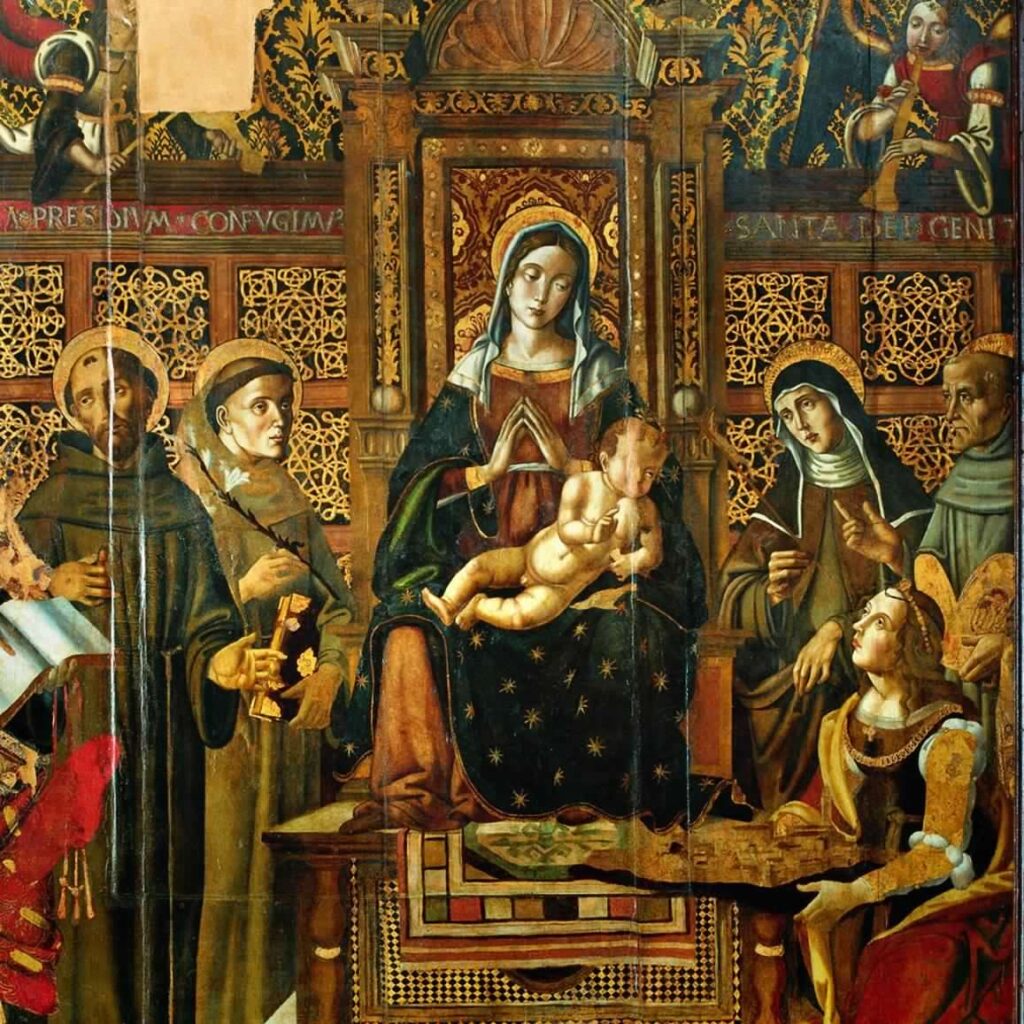
The majesty of the architectural elements suggests the two works belong to the Bramante-Mediterranean cultural context, in a period 1500-07, when De Aponte had already felt the importance of the contribution of Bramantino, the first new man of Lombardy. At the center of them is a large panel Madonna with Child and Saints from the early 1500s, a work close to the methods of Antonio Solario known as "lo Zingaro"; the imposing statue of S. Antonio Abate in carved, gilded and painted wood from the 16th century; triptych with 12 apostles in sculpted, carved, polychromed and gilded wood in the predella and the statues of the Madonna and Child with Saints John the Baptist and Biagio, from the Veneto-Friulan schools of the 16th century. XVI; Polyptych Madonna with Child, St. John the Baptist, St. Peter, St. Paul, St. John the Evangelist, in sculpted, carved, polychromed and gilded wood from the end of the 1400s; Polychromed wooden altarpiece of great value: St. James and 18 panels representing scenes from the life of the Saint, work from the first half of the 1400s from the Moranzon workshop, with a predella at the bottom attributed to Iacobello del Fiore, with twelve figures of male and female saints ; Oil on canvas, copy from Lelio Orsi: Madonna della Ghiara from 1569, which is very reminiscent of Michelangelo in its volumes and shapes; Wooden sculpture, Madonna with child, Abruzzo art, of high artistic value from the 1200s: the Madonna is represented in a popular tone as a rustic matron.
In room no. 5, there is an Announcing Angel and an Annunciated Virgin, oils on canvas by a Neapolitan painter. On the right, two carved wooden statues from the 16th century. depicting SS. Peter and Paul from the end of the 16th century, an oil on canvas Madonna and Child with Saints Benedict and Bernard attributed to Francesco Allegrini, another sculpted wooden statue from the first half of the 17th century. S. Reparata protector of Atri. An altarpiece Resurrection, oil on canvas applied on wood from the end of the 16th century. Deposition, oil on canvas from the second half of the 16th century, by a Neapolitan painter.
Room no. 6 is still dedicated to the Pinacoteca, in fact, upon entering on the right a painted tabernacle in carved wood from the 17th century. coming from the church of S. Domenico. In succession: The Virgin, St. Joachim, and St. Anna, oil on canvas by an anonymous Florentine painter from the first twenty years of the 16th century, sensitive to the influence of Raphael, enriched by a precious period frame; S. Francesco and S. Leonardo attributed to Ippolito Borghese, an Umbrian painter active in southern Italy starting from the last years of the century. XVI; Holy Family and Saints Ignatius of Loyola and Jerome, oil on canvas, by Geronimo Cenatempo, Neapolitan painter, follower of Luca Giordano. Immaculate Madonna with cherubs at her feet, Neapolitan carved and painted wooden statue from the end of the 18th century. Blessed Francesco Ronci, oil on canvas from the end of the eighteenth century. and the Capture of Christ, oil on canvas from the 18th century. copy of an engraving by G.B. Pasqualini of 1621, in turn derived from the original by Guercino, now in the Fitzwilliam Museum in Cambridge.
In room no. 7, on the right, Degree Diploma of Francesco Antonio Saverio Grue, dated 1798. In the centre, in modular showcases, with a particular hut shape, the 100 pieces of the Vincenzo Bindi collection are displayed, consisting of plates, tiles, vases, etc. . mainly from Castelli, but also from other schools, representing almost the entire history of Abruzzo ceramics, from the beginning of the 16th century. to the XIX. On the right, in display cases of the same type as the central ones, other ceramics from Castelli and popular ceramic workshops in Abruzzo, collected and preserved over the years by the canons of the Cathedral Chapter. There are majolica bricks that come from the ceiling of S. Donato in Castelli, works of the Grue (Francesco, Carlantonio, Francesco Antonio Saverio, Anastasio, Liborio, Francesco Saverio and Niccolò Tommaso), of the Gentili (Carmine, Giacomo and Berardino).
There is no lack of Cappelletti: Nicola (1691-1767) and Fedele (1874-1920), Gernaldo Fuina and many other ceramics by unspecified authors and other more recent constituents of the so-called poor ceramics. In the middle, solitary, the Madonna and Child in two-tone, glazed majolica, attributed to Luca della Robbia and executed around 1470. In the background, two large polychrome vases by Francesco Saverio Grue (1720-1755) representing the "Nativity" and "Adoration of the Magi" determined and other more recent constituents of the so-called poor ceramics. In the middle, solitary, the Madonna and Child in glazed two-tone majolica, attributed to Luca della Robbia and executed around 1470.
In room no. 8, in two showcases, a cross reliquary in embossed, chiselled, gilded silver, with enamels and niello from 1435 and the stupendous rock crystal cross, a work of the Venetian school from the end of the 13th century. from the church of S. Francesco in Atri: one of the most prestigious pieces in the Museum and one of the most admired both in the Exhibition of Treasures of the Italian Diocesan Museums in Rome in 1986, and in the Exhibition "Homage to S. Marco" held in the Apartment del Doge, Palazzo Ducale, in Venice from October 1994 to April 1995. Opposite the two crosses, in a large display case, are works by the Ronci brothers, goldsmiths from Atria, among which the bust of S. Reparata made in 1600 and a goblet from 1602 by Valerio Ronci in chiseled and gilded silver. On the right six paintings, oil on canvas, depicting scenes from the life of Jesus by Serafino Tamburelli (Atri 1680-1750), from the school of Francesco Solimena, which served as a guide for the canvases of the Church of S. Domenico and which come from the same Church.
In the center is the large processional cross in embossed and gilded silver, made in Atri in 1518 by Mastro Giovanni from Rosarno di Calabria. Pastoral from the early fifteenth century, of Gothic goldsmithing of French derivation, in embossed, chiselled and niello silver. In the showcases, a very large number of pieces of sacred silverware and goldsmithery are displayed, covering a period of time that goes from the end of the thirteenth century to the first half of the twentieth century. In one of these showcases, a pastoral in carved ivory from the end of the 13th century stands out, used by the first Atrian bishops and a pastoral hedgehog, also in carved ivory, originally painted, with a lamb and a dragon, dating back to the beginning of the 14th century .
Room no. 9, contains works from the early twentieth century, sculpted by Tommaso Illuminati from Atria, brother of the distinguished humanist Prof. Luigi Illuminati, born in Atri in 1883 and who completed his artistic maturation under Ferrari and Bazzani in Rome. There are pieces in wood, bronze and terracotta depicting flowers, sacred figures and heads of characters. Among these: the Annunciation, walnut high relief from 1926, Umbrian peasant, bronze half-bust from 1922.
Source: www.visitatri.it
Il Museo Capitolare fu fondato, su iniziativa di Mons. Raffaele Tini nel 1912.
L’edificio che ospita il museo, fu più volte rimaneggiato nel corso della sua storia. Il Monastero dei Benedettini sorto all’inizio (sec. XII) divenne più tardi (sec. XV) residenza dei canonici e poi (sec. XX) sede del Museo. L’ultima trasformazione radicale si ebbe negli anni ‘60 sotto la direzione del soprintendente Guglielmo Matthiae che ristrutturò tutto l’edificio demolendo e ricostruendo ex novo l’ala nord dello stesso. Vi furono sistemati più razionalmente tutti gli oggetti esposti, compresi gli armadi scolpiti da Carlo Riccione che, dopo la demolizione della sacrestia e del coro interno, furono ricostruiti e sistemati nei primi 2 locali del nuovo museo.
Un’ultima definitiva ristrutturazione, si é avuta nei primi mesi del 1994, quando, grazie alla Soprintendenza, alla Regione Abruzzo e alla Fondazione Tercas. Il Museo in questi ultimi anni si é arricchito di donazioni private come la raccolta di ceramiche di Vincenzo Bindi, donata dal figlio Dott. Gaetano e la raccolta di arte lignea di Tommaso Illuminati donata dagli eredi dello stesso.
LE SALE
All’interno due grandi reliquiari francescani del XVII sec. in legno, con reliquie che provengono dalle catacombe romane; tre portaceri lignei del XVI sec. di buona fattura; lungo le scale una discesa dello Spirito Santo fine XVI sec. e una serie di sei candelieri e croce in legno dorato con Cristo in argento.
Le sale n. 1 e 2 sono dedicate ai mobili da Sagrestia. Nel mezzo un inginocchiatoio, con simbolo francescano, intarsiato a legni vari del XVIII sec; una coppia di Angioletti con portacandele in legno dorato; tre busti reliquiari del XVII sec. raffiguranti S. Prospero, S. Colomba e S. Fedele in legno scolpito e dorato; due armadi e tre ante, in noce di Carlo Riccione tra cui S. Cecilia, S. Chiara e Vanità del potere. Un frammento di balaustra, in legno scolpito, del XVII secolo, raffigurante l’Annunciazione e un olio su tela, Coro interno dei canonici, di Giuseppe Verdecchia, artista locale.
La sala n. 3 è dedicata all’Arte Tessile sacra. Vi si trovano paramenti sacri: pianete, stole, piviali, mitrie del periodo barocco e rococò (sec. XVII e XVIII) in seta, velluto, broccato e damasco con filature in argento e oro. Da notare il tappeto rosso ricamato in argento donato nel 1732 al cardinale Troiano Acquaviva dalla regina d’Inghilterra. Presenti: una coppia di altarini La Maddalena e S. Giovanni, in legno scolpito ed olio su tela del XVIII sec. e una serie di 2 busti reliquiari: S. Maurizio, S. Diodato in legno scolpito e dorato del XVII sec. e una statua della Maddalena.
Nella sala n. 4 si trova la Pinacoteca. Entrando da sinistra: due tavole Natività e Flagellazione attribuite a Pedro de Aponte, pittore di Saragozza, che seguì il Re Ferdinando il Cattolico durante la sua visita a Napoli, ove dovette ottenere l’incarico per le dette tavole dal Duca d’Atri Andrea Matteo III d’Acquaviva.
La maestosità degli elementi architettonici fanno ritenere le due opere nell’alveo culturale bramantesco-mediterraneo, in un periodo 1500-07, quando il De Aponte aveva già avvertito l’importanza dell’apporto del Bramantino, il primo uomo nuovo di Lombardia. Al centro di esse una grande tavola Madonna col Bambino e Santi dei primi del 1500, opera vicina ai modi di Antonio Solario detto “lo Zingaro”; l’imponente statua di S. Antonio Abate in legno scolpito, dorato e dipinto del XVI sec.; trittico con nella predella 12 apostoli in legno scolpito, intagliato, policromato e dorato e le statue Madonna col bambino e i Santi Giovanni Battista e Biagio, di scuole veneto-friulane del sec. XVI; Polittico Madonna col bambino, S. Giovanni Battista, S. Pietro, S. Paolo, S. Giovanni Evangelista, in legno scolpito, intagliato, policromato e dorato della fine del 1400; Ancona lignea policromata di grande pregio: S. Giacomo e 18 formelle che rappresentano scene della vita del Santo, opera della prima metà del 1400 della bottega dei Moranzon, con una predella in basso attribuita a Iacobello del Fiore, con dodici figure di Santi e Sante; Olio su tela, copia da Lelio Orsi: Madonna della Ghiara del 1569, che richiama molto nei volumi e nelle forme Michelangelo; Scultura lignea, Madonna col bimbo, arte abruzzese, di elevato valore artistico del 1200: la Madonna viene rappresentata con tono popolaresco come una rustica matrona.
Nella sala n. 5, si trovano un Angelo Annunciante e Vergine Annunciata, olii su tela di un pittore napoletano. Sulla destra, due statue in legno scolpito del XVI sec. raffiguranti SS. Pietro e Paolo della fine del XVI sec, un olio su tela Madonna col bambino e i santi Benedetto e Bernardo attribuito a Francesco Allegrini, un’altra statua in legno scolpito della prima metà del XVII sec. S. Reparata protettrice di Atri. Una pala d’altare Resurrezione, olio su tela applicata su tavola della fine del XVI sec. Deposizione, olio su tela della seconda metà del XVI sec., di un pittore napoletano.
La sala n. 6 è sempre dedicata alla Pinacoteca, infatti, entrando sulla destra un tabernacolo dipinto, in legno intagliato del XVII sec. proveniente dalla chiesa di S. Domenico. In successione: La Vergine, S. Gioacchino, e S. Anna, olio su tela opera di un anonimo pittore fiorentino del primo ventennio del XVI sec., sensibile all’influenza di Raffaello, arricchita da una preziosa cornice d’epoca; S. Francesco e S. Leonardo attribuiti a Ippolito Borghese, pittore umbro attivo nel meridione d’Italia a partire dagli ultimi anni del sec. XVI; Sacra Famiglia e i Santi Ignazio da Loyola e Girolamo, olio su tela, di Geronimo Cenatempo, pittore napoletano, seguace di Luca Giordano. Madonna Immacolata con ai piedi dei puttini, statua in legno scolpito e dipinto, napoletano della fine del XVIII sec. Beato Francesco Ronci, olio su tela della Fine del XVIII sec. e la Cattura di Cristo, olio su tela del XVIII sec. copia di un’incisione di G.B. Pasqualini del 1621, desunta a sua volta dall’originale del Guercino, ora al Fitzwilliam Museum di Cambridge.
Nella sala n. 7, sulla destra, Diploma di Laurea di Francesco Antonio Saverio Grue, datato 1798, Al centro, in vetrine modulari, dalla particolare forma a capanna, sono esposti i 100 pezzi della raccolta Vincenzo Bindi costituiti da piatti, mattonelle, piastrelle, vasi, ecc. prevalentemente di Castelli, ma anche di altre scuole, rappresentanti pressoché l’intera storia della ceramica d’Abruzzo, dagli inizi del XVI sec. al XIX. Sulla destra in vetrine della stessa tipologia di quelle centrali, altre ceramiche di Castelli e di officine di ceramica popolare abruzzese, raccolte e conservate negli anni dai canonici del Capitolo Cattedrale. Sono presenti mattoni maiolicati che provengono dal soffitto di S. Donato in Castelli, opere dei Grue (Francesco, Carlantonio, Francesco Antonio Saverio, Anastasio, Liborio, Francesco Saverio e Niccolò Tommaso), dei Gentili (Carmine, Giacomo e Berardino).
Non mancano i Cappelletti: Nicola (1691-1767) e Fedele (1874-1920), Gernaldo Fuina e tante altre ceramiche di autori non determinati ed altre più recenti costituenti la cosidetta ceramica povera. Nel mezzo, solitaria, La Madonna col Bimbo maiolica bicolore, invetriata, attribuita a Luca della Robbia ed eseguita verso il 1470. In fondo due grandi vasi policromi di Francesco Saverio Grue (1720-1755) rappresentanti “Natività” e “Adorazione dei Magi” determinati ed altre più recenti costituenti la cosidetta ceramica povera. Nel mezzo, solitaria, La Madonna col Bimbo maiolica bicolore, invetriata, attribuita a Luca della Robbia ed eseguita verso il 1470.
Nella sala n. 8, in due vetrine, un Reliquario a Croce in argento sbalzato, cesellato, dorato, con smalti e niello del 1435 e la stupenda Croce in cristallo di Rocca, un lavoro di scuola veneziana della fine del XIII sec. proveniente dalla chiesa S. Francesco in Atri: un pezzo tra i più prestigiosi del Museo e tra i più ammirati sia nella Mostra dei Tesori dei Musei Diocesani Italiani a Roma nel 1986, che nella Mostra “Omaggio a S. Marco” tenutasi nell’Appartamento del Doge, Palazzo Ducale, a Venezia dall’ottobre 1994 all’aprile 1995. Di fronte alle due croci, in una grande vetrina, opere dei fratelli Ronci, orafi atriani, tra le quali spiccano il busto S. Reparata realizzato nel 1600 e un calice del 1602 di Valerio Ronci in argento cesellato e dorato. Sulla destra sei dipinti, olio su tela, raffiguranti scene della vita di Gesù di Serafino Tamburelli (Atri 1680-1750), della scuola di Francesco Solimena, che servirono da guida per le tele della Chiesa S. Domenico e che provengono dalla stessa Chiesa.
Al centro la grande Croce processionale in argento sbalzato e dorato, eseguita in Atri, nel 1518 da Mastro Giovanni di Rosarno di Calabria. Pastorale dei primi del Quattrocento, di oreficeria gotica di derivazione francese, in argento sbalzato, cesellato e niello. Nelle vetrine é esposto un altissimo numero di pezzi di argenteria e oreficeria sacra che coprono un arco temporale che va dalla fine del Duecento alla prima metà del Novecento. Spiccano in una di queste vetrine, un pastorale in avorio intagliato fine XIII sec., usato dai primi vescovi atriani e un riccio di pastorale, sempre in avorio intagliato, in origine dipinto, con un agnello e un drago, risalente agli inizi del XIV sec.
La sala n. 9, contiene opere del primo novecento, scolpite dall’atriano Tommaso Illuminati, fratello dell’insigne umanista Prof. Luigi Illuminati, nato in Atri nel 1883 e che compì la sua maturazione artistica sotto il Ferrari e il Bazzani a Roma. Vi si notano pezzi in legno, bronzo e terracotta raffiguranti fiori, figure sacre e teste di personaggi. Tra queste: l’Annunciazione, altorilievo in noce del 1926, Contadino umbro, semibusto in bronzo del 1922.
Fonte: www.visitatri.it